American robin
Silent SpringThe American robin is both a recognizable presence in everyday American life and a revealing indicator of pesticide damage in Silent Spring. Rachel Carson traces how chemicals used against insects could reach robins indirectly through earthworms, with consequences extending from poisoning and death to reproductive failure. The bird’s familiar return each spring makes those effects legible as more than an isolated wildlife loss: a routine feature of the landscape becomes evidence of a disrupted ecological relationship.
A familiar bird in a changing landscape
Carson presents the robin as a bird known to nearly everyone. For millions of Americans, the first robin of the season signals that winter’s hold has broken; its arrival is reported in newspapers and welcomed at breakfast tables. That shared familiarity gives the bird’s decline particular force. It is not a remote or obscure species, but one whose presence helps people recognize the changing seasons and whose absence can make environmental damage visible in ordinary life.
The account places the robin within a broader concern about birds across the Appalachian region, where one observer reported an “incredible reduction” in West Virginia’s bird population. Against that regional decline, the robin’s story serves as a warning about a fate already overtaking some species and threatening others. The bird thus occupies two roles at once: a living participant in a damaged environment and a familiar emblem through which the scale of that damage can be understood.
Spraying and the food-web route
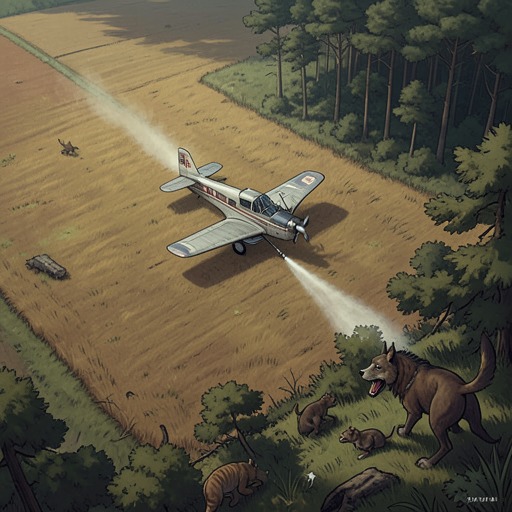
The threat described in the book follows the spread of intensive spraying against Dutch elm disease. Across communities in the Midwest and New England, especially in areas where American elms were common, spraying had become routine. At Michigan State University, ornithologist George Wallace and graduate student John Mehner investigated what the practice could mean for bird life, particularly for robins.
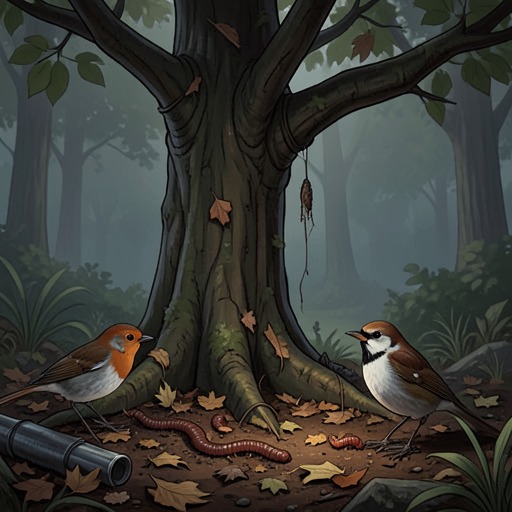
The account emphasizes that exposure did not have to come chiefly from a bird’s direct contact with insecticide. A more consequential route ran through earthworms. In one research project, campus earthworms were inadvertently fed to crayfish, and the crayfish died. Carson uses this finding to help explain the danger in a robin’s ordinary feeding behavior: chemicals applied in one part of the environment could persist in organisms that survived exposure and then be eaten by birds.
Earthworms could retain poison in their digestive tracts, blood vessels, nerves, and body walls. Some died, but others survived as “biological magnifiers” of the contamination. When robins returned in spring and resumed feeding, the worms formed a link between treated environments and the birds. As few as 11 large earthworms could carry a lethal dose of DDT to a robin; that quantity was only a small part of a day’s food for a bird capable of eating 10 to 12 worms in as many minutes. The figures make the route of exposure concrete: a dose capable of killing a bird could be accumulated through an ordinary meal.
Death and reproductive failure
Not every robin received a lethal dose, but Carson’s account does not treat survival from immediate poisoning as safety. She describes the failure to produce young as a further consequence. One factor was the death of one or both birds in a pair before the nesting cycle was complete. Wallace’s records, however, pointed to something beyond the loss of adults: the birds’ capacity to reproduce could itself be damaged.
The distinction broadens the significance of the robin’s decline. A count of dead birds would capture only part of the harm. When surviving birds fail to produce young, pesticide effects reach into the continuation of a population, and the consequences may accumulate without a single dramatic moment of mass death. In this account, the absence of fledglings is evidence in its own right, revealing damage that can remain less conspicuous than a carcass yet threaten a species’ future.
Public risk and chemical-control campaigns
The robin’s case belongs to Carson’s wider challenge to the routine use of long-lasting poisons. In 1958, when she undertook the book that became Silent Spring, she was fifty and had spent much of her professional life as a marine biologist and writer with the U.S. Fish and Wildlife Service. She and her scientific colleagues had become alarmed by the widespread use of DDT and other persistent poisons in agricultural control programs. She decided that the destruction of wildlife and habitat, and the danger to human life, required public attention.
That effort encountered resistance before the book appeared. Magazine publishers turned down her proposed article, fearing the loss of advertising; one canned baby-food manufacturer objected that it would cause “unwarranted fear” among mothers who used the product. The robin’s story therefore unfolds within a contest over how pesticide danger would be described and whether it would be made public. Its evidence moves from spraying, through worms, to bird death and reproductive failure, while the surrounding controversy shows how economic and official interests could shape the terms of public concern.
Carson also describes the power of government publicity to define a pest as an emergency. In 1957, the United States Department of Agriculture launched a major campaign against the fire ant, portraying it as a threat to southern agriculture and to wildlife, including the young of ground-nesting birds. The resulting control program treated a million acres in its first year, while later studies by state and federal wildlife agencies and universities documented severe losses, in some treated areas the complete destruction of wildlife. Poultry, livestock, and pets were also killed. In that wider pattern, the robin’s story exposes the imbalance in a policy that frames insects as targets while leaving the wider ecological costs of broad-spectrum treatment to emerge afterward.
The book’s account of woodcocks adds another example of how poison could travel through earthworms. Birds wintering in Louisiana and breeding farther north carried residues of fire-ant pesticides; the route was traced to their heavy feeding on worms in treated areas. The robin and the woodcock are distinct cases, but together they show why the earthworm matters in Carson’s argument: it connects chemical treatment on the ground to birds that feed there, and can extend contamination beyond the immediate site of application. Through the robin, a familiar sign of spring becomes a measure of how far such effects can reach.